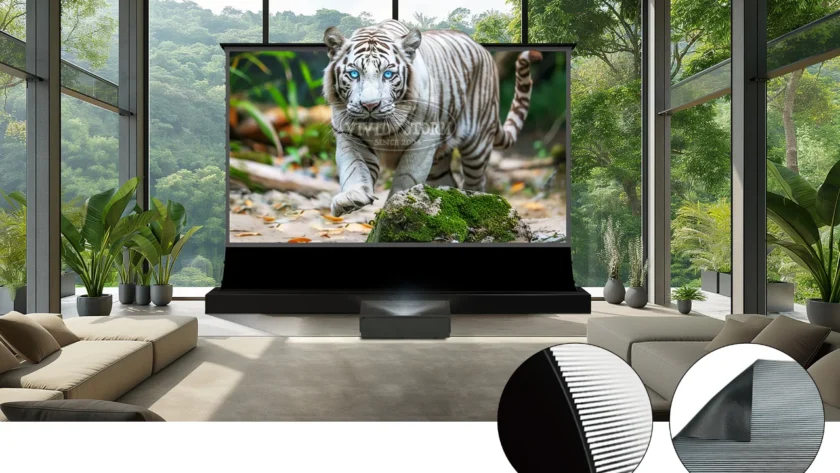
You finally bought a quality UST laser projector — then realized your existing screen won’t cut it.
A floor rising projector screen is a motorized screen that rises from a base unit on the floor, retracting cleanly when not in use. In contrast to wall-mounted or ceiling-drop versions, the model doesn’t need any installation at all and is removed from the room when you’ve finished watching. In open-plan or complex-ceilinged living spaces, it’s usually the only feasible option to the large-screen arrangement.
Ambient Light Is the Real Problem (Not the Screen Size)
Most buyers fixate on inches. The screen size is almost irrelevant if your screen material can’t handle the room.
Here’s the thing: a 120-inch matte white screen in a bright living room doesn’t look like a cinema. It looks washed out, low-contrast, and frankly worse than a 65-inch TV. The enemy isn’t throw distance or projector lumens — it’s reflected ambient light bouncing back off the screen surface directly into your eyes.
The global projector screen market was valued at $10.75 billion in 2024 and is projected to reach $20.69 billion by 2031, growing at a 9.8% CAGR — with ALR technology adoption cited as one of the key accelerating factors (Reanin Market Research, 2025). The shift isn’t toward bigger screens. It’s toward smarter screen materials.
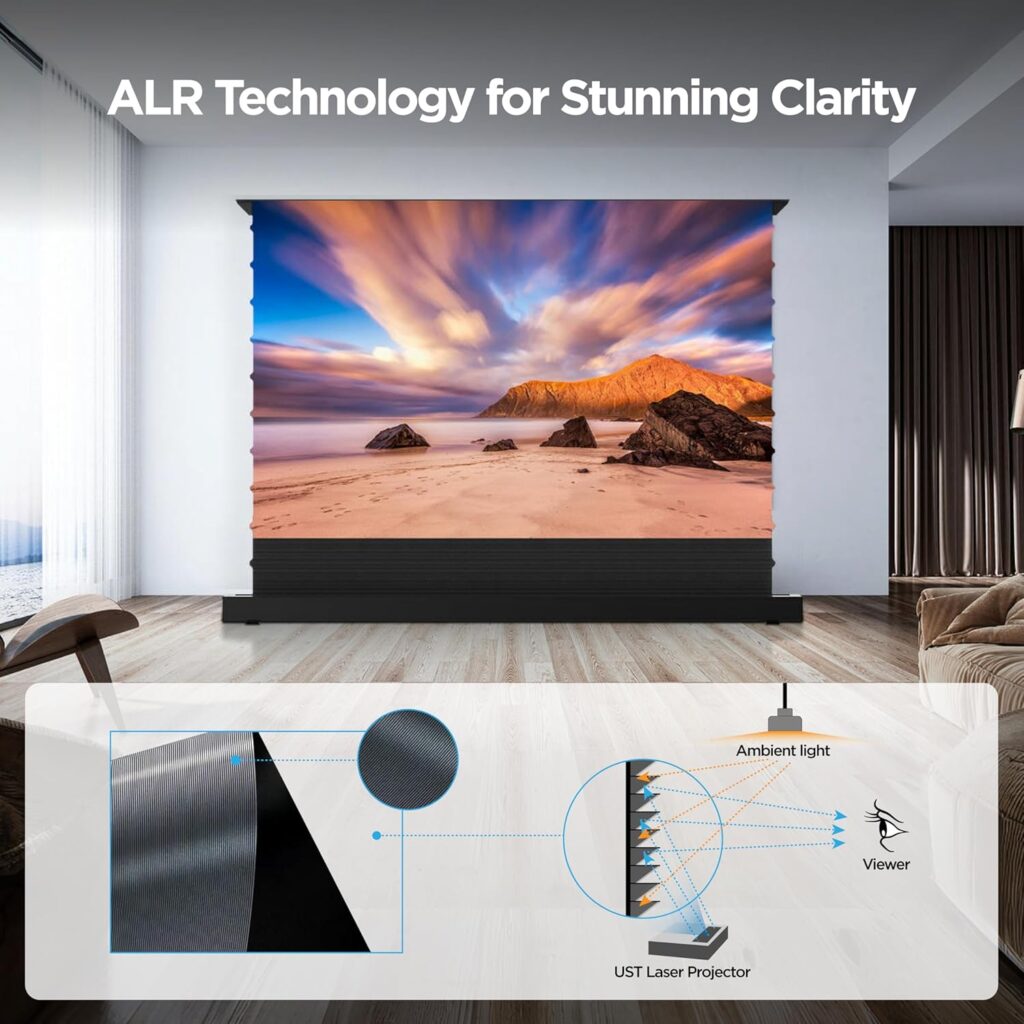
The ALR (Ambient Light Rejecting) screens use a lenticular or optical surface that rejects the ambient light overhead and at side angles while reflecting all light from your specific angle of projected throw back toward the viewer—the result: blacker blacks, punchier colors and a watchable image even with the ceiling lights on.
CLR (Ceiling Light Rejecting) is a stricter subset of ALR — designed specifically for ultra-short throw projectors that project from very shallow angles below the screen. It’s more aggressive at rejecting downlight and is the correct choice for UST setups.
Most guides stop here. They won’t tell you the counterintuitive part.
Counter-intuitive insight: A 0.6-gain ALR screen can look brighter and more vivid than a 1.0-gain matte white screen in the same room. Gain measures raw reflectivity — but perceived contrast is what your eye actually responds to. A 0.6-gain CLR surface rejects ambient light so effectively that the image appears to “pop” even though it’s reflecting less total light. Independent testing of the NothingProjector Black Series 0.6-gain screen found that in dark rooms with ceiling downlights active, it rejected overhead light with ease and maintained convincingly black screen levels — meaning perceived contrast is high precisely because the surface absorbs rather than scatters ambient light.
Floor Rising Projector Screen vs Ceiling Mounted: Which Actually Makes Sense?
Look — if you’re in a dedicated home theater room with a dropped ceiling and an AV installer on speed dial, a recessed ceiling screen is unbeatable. But that’s not most people reading this.
Quick Comparison Between Floor Rising Projector Screen and Ceiling Mounted Screen
| Option | Best For | Key Benefit | Limitation |
|---|---|---|---|
| Floor rising projector screen | Living rooms, open-plan, rentals | No installation, disappears when not in use | Higher cost; base unit takes floor space |
| Ceiling recessed screen | Dedicated theater rooms | Completely invisible when stored | Requires construction; not renter-friendly |
| Wall-mounted fixed frame | Dedicated dark rooms | Best image flatness, lowest cost | Permanent; visible 24/7 |
| Pull-up portable | Occasional use, travel | Very cheap | Poor tension, waviness, no ALR options |
The AVS Forum community has discussed this trade-off extensively. A recurring frustration among users is that ceiling construction often prevents recessing a drop screen, making a floor rising projector screen solution the most practical option — though real-world users have raised concerns about edge waviness on certain models.
That waviness issue matters. It’s one of the most under-reported problems in floor-riser reviews, and we address it directly for each model below.
The 4 Floor Rising Projector Screens Worth Buying in 2026
Or maybe I should say it this way — there are dozens of brands for floor rising projector screen, but only a handful with real-world track records, consistent ALR performance, and enough verified buyer reviews to trust. These four represent the current tier worth spending money on.
1. VIVIDSTORM S PRO Motorized UST ALR Floor Rising Projector Screen
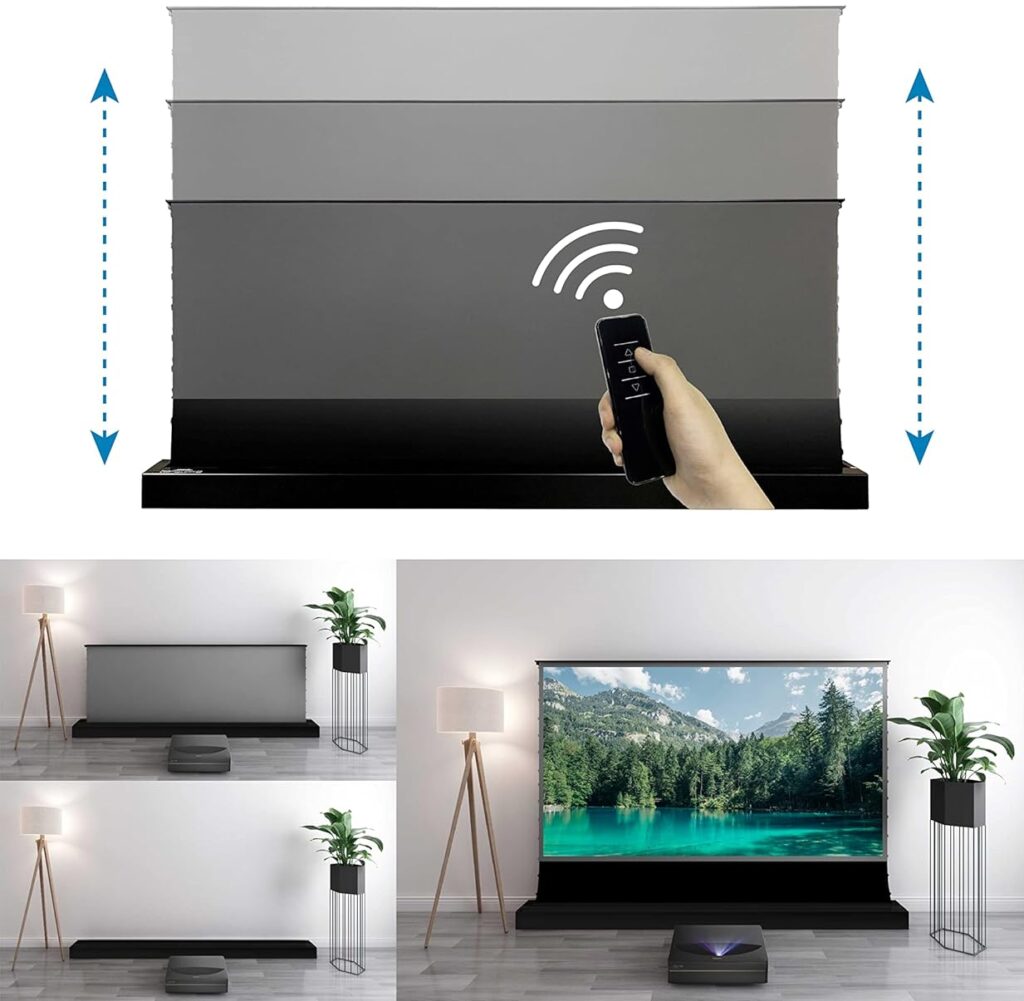
VIVIDSTORM has been manufacturing motorized screens since 2004 and is one of the most widely reviewed brands in this category. Their floor rising projector screen series uses proprietary Wire Tension Technology for a flatness described as “glass surface,” with the screen rising smoothly from the housing and retracting completely when not in use — all controlled via app, voice assistant, or RF remote.
The VSDSTUST120H model (120-inch, UST ALR) and S PRO PLUS variants are actively listed with a 2-year manufacturer warranty. The 120-inch UST model features a 0.6 gain, 170-degree viewing angle, 97% ALR resistance, and is exclusively compatible with ultra-short throw laser projectors — not suited for standard throw setups.
One honest note: some users on enthusiast forums have noted that budget VIVIDSTORM variants can exhibit edge waviness, and the brand has reportedly acknowledged that projecting to the very edges may reveal slight surface inconsistencies on certain models. The S PRO and S PRO PLUS lines address this with upgraded tension systems and DC motors — stick to those over the entry-level models.
Best for: UST projector owners, app/voice control, and proven brand support at a mid-range price point.
2. AWOL VISION ALR-F220C Motorized ALR Floor Rising Projector Screen
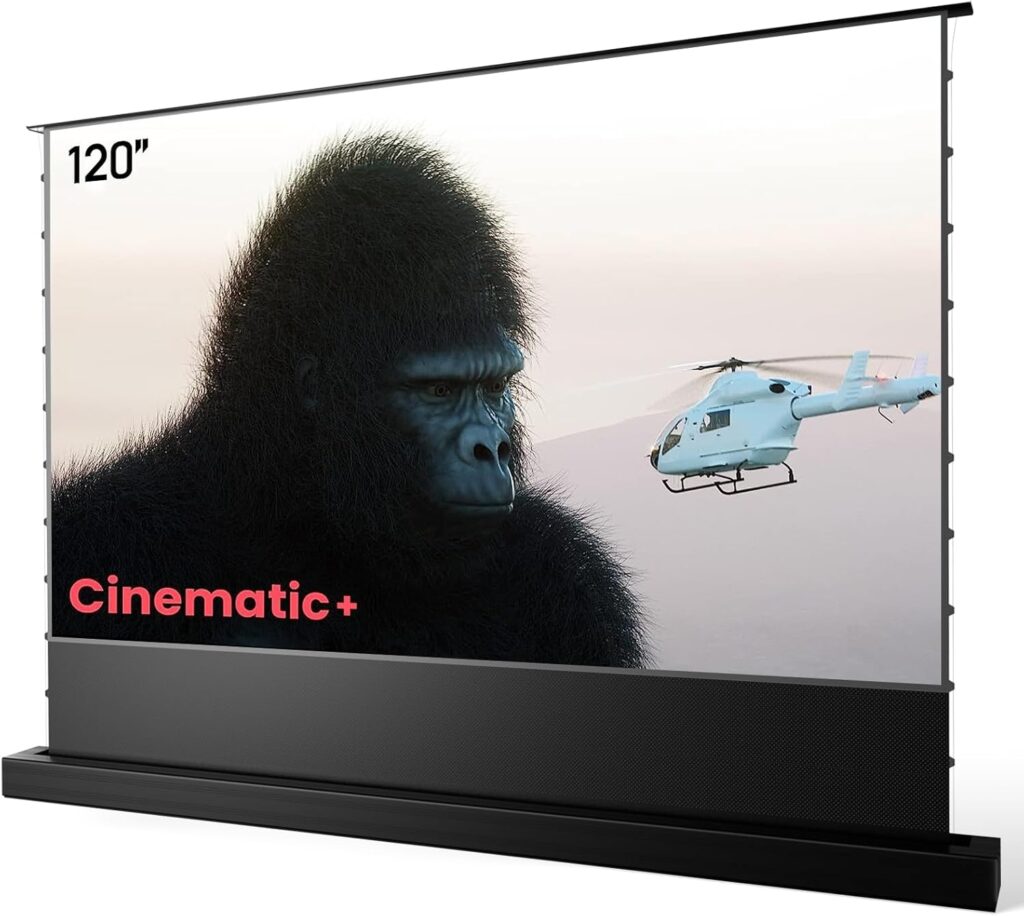
The AWOL VISION ALR-F220C features a premium HBSI ALR screen material with over 50% enhanced gain compared to standard CBSP screens, a 170-degree viewing angle with 0.8 peak gain, USB synchronization that automatically raises the screen when the projector powers on, and an acoustic transparent design for speaker-behind-screen integration.
Both 100-inch (ALR-F210C) and 120-inch (ALR-F220C) variants are sold directly. The smart control box includes a memory function for setting preferred rise height, and the cirriform optical surface lens microstructure blocks up to 95% of ambient light.
It’s the strongest all-rounder for buyers whose projector setup isn’t strictly UST — the 0.8 gain and 170-degree viewing angle make it more forgiving across different throw distances than CLR-only screens.
Best for: Buyers with standard short-throw or ceiling-mounted projectors who still want motorized floor rising projector screen convenience and strong ambient light performance.
3. NothingProjector Motorized ALR Screen (NothPJ)
NothingProjector’s motorized floor-rising ALR screens are listed under the “NothPJ” seller name. The screen rises automatically when the projector powers on and retracts when it turns off, features a 170-degree wide viewing angle, ST Carbon Black surface for 4K UHD clarity, and a micro-perforated acoustic surface with 0.4mm precision perforations for sound transmission without light loss.
The 100-inch model with 85% ALR features a 0.85 gain screen with a 20,000:1 contrast ratio and 96.5% color saturation, with a fast 30-second silent motorized lift. The 95% ALR Black Series variant (available in 100″, 120″, and 130″) steps up to a 0.6-gain CLR surface engineered specifically for UST projectors.
I’ve seen conflicting data on off-axis viewing beyond 35 degrees — some reviewers flag brightness falloff at extreme angles, others say it’s negligible in standard seating arrangements. My read is that for a centered sofa arrangement, it’s a non-issue. Wide L-shaped seating layouts might warrant in-person testing first.
Best for: UST projector owners prioritizing the best ambient light rejection available, with smart home integration and acoustic transparency.
4. Elite Screens Kestrel Tab-Tension 3 / Tab-Tension CLR
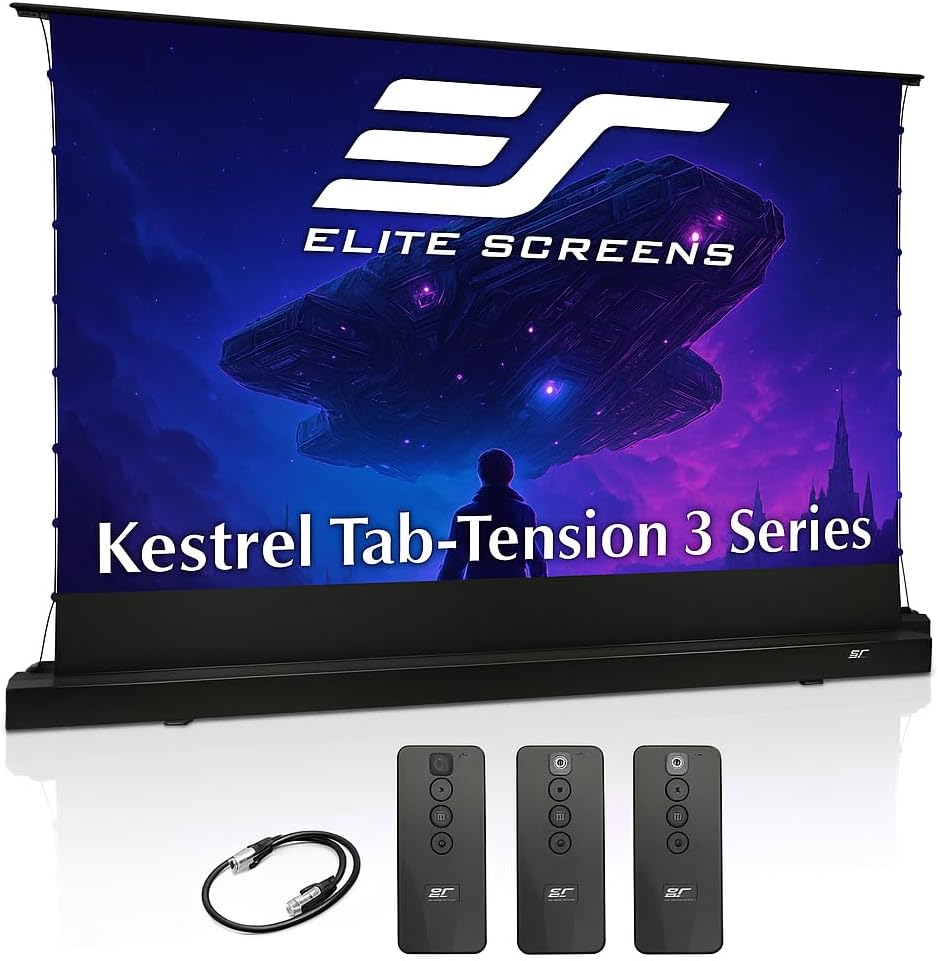
Elite Screens is a California-based ISO9001 manufacturer founded in 2004 with one of the widest screen size selections in the floor rising projector screen category. The Kestrel Tab-Tension 3 series uses a scissor-backed cross spring riser system, is ISF certified for accurate color reproduction, includes both IR and RF remotes with a wireless 12V projector trigger, and offers UL GREENGUARD certification for indoor air quality compliance.
The Kestrel Tab-Tension CLR variant features StarBright CLR material with a 0.6 gain and 180-degree viewing angle, blocking 95% of overhead light while enhancing contrast 100x compared to standard matte white screens — exclusively for ultra-short throw projectors.
Some experts argue that Elite Screens is simply a budget brand selling on price. That’s valid for their entry-level matte white lines. But the Kestrel CLR series is a genuinely competitive UST screen with ISF certification and a longer warranty track record than newer. If you want a US-based company with established after-sales support, Elite is the safest long-term bet.
Best for: Buyers who want ISF-certified color accuracy, a US-based brand with lifetime tech support, and screen sizes from 122″ up to 183″.
How to Choose the Right Floor Rising Projector Screen for Your Setup
To choose the right floor rising projector screen, follow these steps:
- Confirm your projector type — UST, short throw, or standard throw. ALR and CLR materials are engineered for specific throw angles; using the wrong one defeats the purpose entirely.
- Measure your available floor space. Floor rising projector screens require 12″–18″ of base depth; confirm the unit clears furniture and foot traffic paths.
- Match screen size to viewing distance. Aim for a screen diagonal roughly equal to half your viewing distance in inches — a 120-inch viewing distance works well with a 100″–120″ screen.
- Check projector synchronization support. Premium models like AWOL VISION and NothingProjector support USB auto-sync — the screen rises when the projector powers on and retracts automatically on power-off.
Quick note: Weight matters more than most buyers expect. Heavier cassette designs provide better rigidity and screen flatness during the rise-and-retract cycle — but two-person handling during initial placement is recommended.
Best ALR projector screens comparison → “ALR screen buying guide.”
Voice Search Q&A About Floor Rising Projector Screens
Question: What’s the top floor rising projector screen for a bright living space?
Answer: The NothingProjector Black Series 95 percent ALR (NothPJ) and VIVIDSTORM S PRO are top choices for bright rooms using the UST projector. Both feature 0.6-gain CLR surfaces and motorized auto-sync.
Question: How can I determine whether a floor rising projector screen can be used on my projection device?
Answer: Make sure your projector is an ultra-short throw (UST), short throw or standard throw. CLR screens, such as those from Elite Screens like the Kestrel and VIVIDSTORM SPRO, only work in conjunction with UST projectors. The AWOL Vision F220C is an array of throw models.
Question: Do I need an elevated floor rising projector screen, or an a-ceiling mounted screen?
Answer: Ceiling-mounted screens are more suitable in the event that you have a theater with a permanent installation. Floor rising projector screens are a good option in the event that ceiling mounting isn’t an option, and you’re renting the space screens, or you require the screen to go away when it’s not being used.
Question: Why do lower-gain screens appear better in a brighter room?
Answer: Screens with lower-gains filter out more ambient light, which increases perceived contrast, even when they reflect less raw light. In a bright room, the 0.6-gain CLR screen can significantly overtake one with a 1.0-gain glossy white.
Question: When should I stay clear of an inclining floor-to-floor projector screen?
Answer: Avoid them if you need the widest possible off-axis viewing (fixed-frame screens perform better), if your budget is under $500 (quality motorized ALR floor-risers start around $700), or if your room layout requires the screen against a wall with no floor clearance for the base unit.
The Bottom Line: Which Floor Rising Projector Screen Should You Buy?
Floor rising projector screen choice comes down to one thing: your projector type.
UST projector owner in a bright living room? Go with the NothingProjector Black Series if budget allows, or the VIVIDSTORM S PRO if you want a more established brand with app and voice control. Both deliver 0.6-gain CLR performance that genuinely transforms daytime viewing.
Standard or short-throw projector setup? The AWOL VISION ALR-F220C is your pick — the 0.8 gain and 170-degree viewing angle make it the most forgiving screen across different projection distances, and the USB auto-sync is one of the most useful quality-of-life features in the category.
Want ISF-certified color accuracy and US-based lifetime support? Elite Screens Kestrel Tab-Tension CLR is the safest long-term investment, especially if you’re sizing up to 150″ or 183″.
These information about floor rising projector screens are gathered from different surveys, medical tests and tech giants like Amazon, Techradar and more. Our top priority is to provide you valuable information about floor rising projector screens.
For More Details About Different Projectors Click Here


[…] For More Details About Different Projectors Click Here […]