LED Projector Guide for 2026: What It Works, Costs, and How to Purchase in 2026
An LED projector is a type of projector that makes use of light-emitting diodes instead of the traditional mercury lamp to produce its image. Since LEDs are solid-state components, they are able to last for between 20,000 and more than 30,000 hours without the replacement of bulbs, as well as being quieter and cooler than lamp-based models.
The only difference is the sealed, long-life light source rather than a replaceable bulb, which is why LED is now the standard option for portable projectors, affordable home theater sets, as well as small classrooms. However, it’s not the “best” option for every room. LED projectors still have an advantage in pure brightness, and the cheapest lamps still have a chance to win due to their upfront price. This guide will explain the precise location of LED projectors, how they function, and what models are worth looking at today.
How an LED Projector Actually Works?
In an LED projector, the red, green, and blue diode clusters emit glowing colors directly via electroluminescence. It’s basically the same low-heat, low-power method employed in LED projectors lighting bulbs and displays. This light is then routed through the optical path on an imaging chip, which is most often a DLP chip composed of millions of mirrors; however, some models employ LCD as well as LCoS displays instead.
Because there’s no gas ignited by pressure (as is the case with a traditional UHP lamp), the entire unit runs more efficiently. It has a few knock-on effects
- There is no 60-90 second warm-up and cooling-down time. The image will be bright and vibrant almost immediately.
- Smaller, quieter cooling fans
- No bulb will burn out, dim in a random manner, or require replacement every year or so
The cost is the brightness ceiling. The pressure of pushing any LED lighting source over the limit of output can result in damage to color accuracy and shorten its life; that’s the reason why many LED projectors have a lower level of 2,500 lux, whereas laser models typically have 3,000+.
LED Projector vs Laser projector vs Lamp projector : The Real Comparison
This is the most frequently used decision point for those shopping in this market. It usually boils down to three figures: longevity or brightness, as well as the cost per hour.
| Factor | LED | Lamp (UHP) | Laser |
| Average life span | 20,000-30,000+ hrs | 2,000-6,000 hrs | 20,000-30,000+ hrs |
| Cost of replacing the bulb | None (sealed) | $150-$400 every 3 to 5 years of continuous usage | None (sealed) |
| Peak brightness | Usually less than 2,500 lumens | Moderate-high | Often 3,000+ lumens |
| Warm-up/cool-down | Instant | 30-90 seconds | Instant |
| The typical price range | Budget-midrange | Budget | Midrange-premium |
| Best fit | The dark rooms are not portable, but they’re also dark low maintenance | Budgets that are tight, occasional use | Bright rooms, big screens and home theater |
If you calculate the numbers over five years, an LED projector is usually more affordable overall than a lamp -even if the lamp projector came with the lower price at the checkout- because you don’t have to buy bulbs every year or two.
One newer area worth learning about is the light source that is a hybrid of LED projector and laser projector, often referred to as “HybridBeam.” They blend an LED projector base and an assist from lasers to boost brightness without the shift in color that high-output LED projectors are susceptible to. It’s a small portion of the market, but it’s where a lot of mid-range brands are taking it.
The ANSI Lumens Problem (Read This Before You Buy)
This is the primary reason for buyer’s remorse within this area. Manufacturers frequently declare “LED lumens” or just “lumens” on the box — and the numbers can be exaggerated by up to 10 times more than the actual measurement, which is ANSI lumens.
ANSI lumens can be described as a well-established test method. If the listing does not mention “ANSI,” treat the claims of brightness with serious suspicion and search for reviews from third parties that have measured the actual output. A projector with a power of around 500 ANSI lumens could still perform in a different way than one that claims “5000 lumens” with no ANSI qualification, despite the possibility that both numbers will be displayed in the search results.
An excellent rule of thumb to judge how bright a space is:
- Small-to-medium screen sizes, ranging from 300 to 800 ANSI lumens, are enough.
- For some light (curtains or use at night using the lamp), try to get 1,000- 1,500 ANSI lumens.
- Use in bright rooms or during the day. LEDs alone aren’t sufficient. Consider laser or hybrid models instead.
Resolution: What “4K” Actually Means Here
Many LED projectors claim to support “4K” when what they actually refer to is a four-channel input. The LED projector is able to take a 4K signal from your streaming device or console; however, it displays the image at the lower resolution of native, usually 1080p. This is done by pixel-shifting or downscaling in order to give you a rough idea of 4K resolution.
It’s not a problem. If you’re planning to view an action film on a tiny screen, the distinction could be difficult to see. If crisp, natural 4K details are important for you — especially for large screens or long viewing distances- make sure you check the native resolution specifications specifically instead of only that “4K supported” badge.
Is an LED Projector Good for Gaming?
Certain projectors are dependent on input lag, which isn’t exactly the same as brightness or resolution. For competitive gamers, it is common to have input lag of less than 20 milliseconds during game mode. A lot of mid-tier LED projectors are within the 16-18ms range once game mode is activated and are truly competitive.
Ultra-short-throw (UST) models are the exception, as their image processing system usually increases latency by 10-15ms and can be significant enough to make a difference in titles that are fast-paced. If gaming is your primary concern, make sure you know the exact amount of input lag, rather than thinking that any “gaming mode” label is similarly speedy.
Who Should Actually Buy an LED Projector
- Movers and renters -there is nothing to break in the transit area, and there is no bulb to safeguard
- Home theater enthusiasts who are casual and have rooms that are somewhat darkened
- Parents creating a low-heat, maintenance-free screen for their children’s room
- Presenters and travelers who need an easy-to-carry projector for their pico that fits into bags
- Small classrooms or huddle spaces where the upfront cost and ongoing expense is more important than brightness
Who to avoid: Anyone who is projecting on screens larger than 120 inches that have actual ambient light. Lasers and hybrids are the most suitable alternative.
Avoiding Mistakes:
- The brightness is checked for several brands, without verifying that they’re certified by ANSI.
- Purchase a sub-1,000 lumen LED projector for a living space with windows.
- In the event that “gaming mode” automatically means low input lag. Check the actual millisecond number.
- The screen is not necessary; even a $100 white matte screen significantly improves contrast when compared to an unpainted wall.
- When choosing the UST (ultra-short-throw) design for gaming competition without examining the processing latency
8 LED Projectors Worth Comparing
Below are the current LED and hybrid models that appear frequently in independent tests and reviews from buyers up to 2026. Prices change on Amazon frequently, so consider these as a generalization of prices instead of exact prices for checkout. Always verify the prices and specifications on the product’s listing prior to purchasing.
| Product | Best For | Approx. Price Range |
| XGIMI Halo+ | Portable plug-and-play use | Mid-budget |
| NexiGo PJ40 Pro | The best overall budget choice ($100-$500 level) | Budget |
| Anker Nebula Mars 3 Air | Outdoor/portable movie nights | Mid-budget |
| Hisense M2 Pro | Home theaters that are entry-level | Budget-mid |
| JMGO N1 Ultra | Sharper and smoother shadows | Mid-premium |
| Elephas W1K | A budget-friendly alternative that has a striking contrast | Budget |
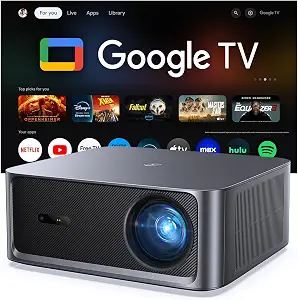
| NexiGo PJ40 Pro (Google TV variant) | Households that stream first | Budget-mid |
| AuKing Mini Projector | Ultra-budget for occasional or casual use | Entry-level |
1. XGIMI Halo+:

It’s designed around plug-and-play simplicity. Power it on, and it will set itself up, making it an ideal choice for those who don’t need to bother with alignment or focus. This light source has been designed to last for at least 30000 hours, which means that continuous use for hours in the night could last for a long period of time. Its matte gray finish and its slim body, make it easy for you to transfer from one room room, or take it out for a night at the park.
2. NexiGo PJ40 Pro:
![[Built-in Apps/4K Support] Smart Outdoor Projector with WiFi and Bluetooth, Movie Projector, DoIby Audio with Dual Speake...](https://m.media-amazon.com/images/I/71dnuLKAfoL._AC_UY218_.jpg)
It has consistently risen to the top of head-tohead tests beating more than 12 rivals within the $100-$500 price range. It stands out due to its contrast, brightness, and image processing that go above and beyond its price, and it comes with a legitimate, authentic Google TV interface rather than an app that is loaded. The most significant drawback that reviewers have noted is that there’s a lot of noise from fans when they’re at their highest brightness.
3. Anker Nebula Mars 3 Air:

The product is designed to be portable and for outdoor use, with a style designed to be able to move easily and stand up to the most informal backyard settings. It is a combination of LED brightness and Anker’s usual emphasis on battery efficiency and wireless connectivity. It’s a great option for those seeking an LCD projector that can be used indoors and outdoors.
4. Hisense M2 Pro:

It is positioned as an accessible way to get into home theaters, while balancing image quality and an affordable price compared to higher-end laser models. It’s not as powerful as premium models in brightness, but in a room that is moderately dark, it offers a lot more polish than the typical ultra-budget models. It’s an acceptable “first real projector” pick.
5. JMGO N1 Ultra:

It brings more sophisticated image processing capabilities to the table and includes technology to reduce visual distortion and increase shadow quality. This results in a more natural-looking image in dark environments, compared to less expensive LEDs. It’s priced higher than the less expensive options, which reflects the extra quality of processing.
6. Elephas W1K:

It is consistently a top pick in shootouts that focus on budget due to its brightness and its contrast compared to its price. It’s not equipped with the advanced-platform look of higher-end models; however, it’s for those who want a huge picture that is watchable without spending a lot and still have a good value against competitors that are similar in price.
7. Google TV’s Google TV variant:

The target audience is households that stream a lot and require a licensed app experience straight out of the box – without the hassle of sideloading Netflix or battling with an unofficial store. It has the same fundamental advantages as the regular PJ40 Pro, with the smart platform being the key distinct feature.
8. AuKing Mini Projector:

This model is at the very low end of the market, being inexpensive, basic, easy to use, and suitable for casual or occasional usage rather than a main home theater system. It’s not going to have the brightness or the processing power of the models mentioned above; however, it’s a good choice for a spare space or dorm, or for the first-time buyer who wants to see if they actually enjoy movie evenings. It’s a safe approach.
FAQ
1. What is the lifespan expected for Projectors powered by LED?
The LED light source usually will last for longer than 30,000 hours in use in comparison to between 26,000-6,000 hours with the traditional bulbs.
2.Do laser or LED projectors better for your home theater than Projectors with LCD screens?
Lasers are generally better in terms of color and brightness in rooms that have greater luminosity or greater spaces, while LED provides solid solutions at a lower cost, which is ideal for smaller, less dark home theaters.
3. Does LED projection equipment have the ability to display HD resolution?
Many people are able to accept 4K as an input, but most are lower than what you see in real life, typically 1080p. This means that the quality is diminished and cannot be presented in its full resolution.
4. Do LED projectors have enough brightness? Bright enough to be utilized during daylight hours?
Usually not on their own. The majority of LED projectors are for dim or dark spaces. Daytime or bright-room usage generally requires a hybrid or laser model.
5. What is the distinction between LED lumens as well as ANSI lumens?
ANSI lumens is an established brightness test; “LED lumens” or unqualified “lumens” figures on packaging can be exaggerated 5-10x more than the real ANSI-measured output.
6. Are LEDs prone to overheating?
Rarely, and less frequently than lamp-based units. The electroluminescence process produces significantly less heat, which is one reason why LED projectors use smaller and quieter fans.
7. Does a greater lumen number always mean the best?
Not necessarily. A bright but insufficient lumen count that does not have an ANSI rating will tell you much — a correctly measured and lower ANSI number can be superior to the marketing numbers that are exaggerated in the real world.
8. Does a projector with LEDs require bulbs replaced?
No. It’s a sealed engine and not meant to be changed. It’s designed to last longer than the other components of the projector in normal use.
Conclusion
An LED projector may be the ideal choice if low maintenance costs, silent operation and portability are of primary concern to you over brightness. Before purchasing one, check the ambient light levels of your room as well as looking for lumens rated by ANSI rather than marketing figures before reviewing resolution and input lag specifications to match how you plan to utilize this device. After that, you can compare a few of the latest models — similar to the ones listed above with your room’s requirements as well as your budget; this will be the quickest method to find the best one.
These information about LED Projector are gathered from different surveys, medical tests and tech giants like Amazon, Techradar and more. Our top priority is to provide you valuable information about LED Projector.
For More Details About Different Projectors Click Here
