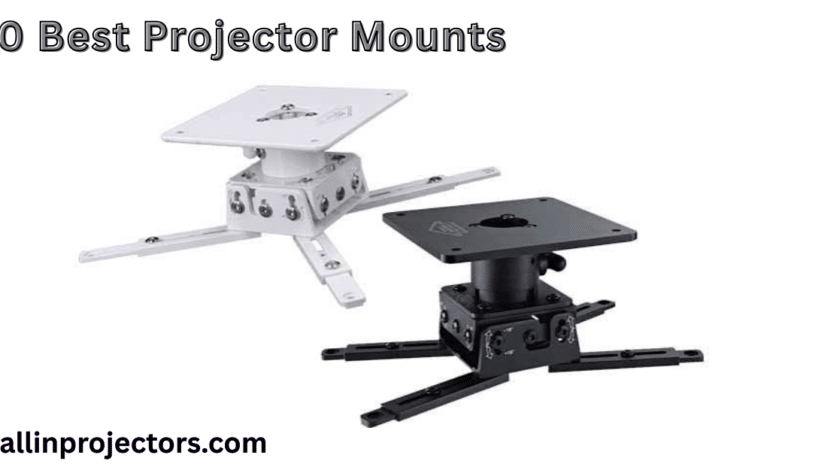
Projector Mount Guide: Types, Sizing, Installation & Cost Explained
The projector mount can be described as a brace that attaches a projector to a wall, ceiling, or shelf to ensure that the image remains aligned, clear, and free of the blurring that is caused by the placement of tables. It may sound like a minor device, but it’s an important difference in a clear image that is centered and clear, as opposed to an image that’s distorted and always readjusting.
If you’ve just purchased a projector mount or are making the decision to turn your spare room into a theater for your home, the choice of projector mount is more than what most people think. If you don’t make it right, you’ll be trapped with keystone distortion, unsteady setups, as well as a mounting system that isn’t able to support the weight. When you get it right, the projector mount disappears completely in the room.
This guide will explain what a projector mount actually does, who requires one, and the various types of projector mounts available; how to measure and set it up correctly; as well as the price and the blunders that cause the most problems for new installers.
Why a Projector Mount Actually Matters
A projector mount isn’t just about tidiness. It affects the quality of images and security, as well as the ease of use your space has all day long.
When a projector mount is placed unsupported on a table or shelf, small bumps can shift the focus and disrupt the keystone alignment – the trapezoid-shaped distortion that occurs when the image doesn’t hit the screen straight on. A projector mount secures the projector’s location forever, which helps keep the geometry constant each time you switch the projector mount on.
There’s also a safety angle easily overlooked. In offices, classrooms, and even living rooms, a projector mount that is not securely mounted on a wall is very dangerous -one mishap and it’s on the floor. A properly rated projector mount secured to an underlying frame or stud takes away the risk completely.
In practical terms, mounting frees up your table and floor space. There’s no obstruction to the flow of traffic or cables dangling all over your room, and no changing the angle each time someone passes by it.
Do You Actually Need Projector Mount?
Some setups do not require a permanent mount. It is all about the length that the projector mount will be in a specific location and the way in which the space is utilized.
Situation Projector Mount Recommended?
- A dedicated home theater room Yes — ceiling mount
- Living room and multi-purpose space Often, low-profile ceiling or shelf mount
- Classroom Yes, ceiling mounts equipped with tamper-resistant hardware
- Conference room Yes, ceiling or recessed mount
- Backyard movie nights No tripods or floor stands
- Apartment rental Wall mounts or floor stands (less drilling)
If the projector mount stays in place for months or even years and the screen is fixed mounting, the projector mount will pay for itself quickly. If the projector mount setup is moved around or you’re renting an existing stand, it’s a wall mount that’s the more appropriate option.
Types of Projector Mounts
1. Ceiling-mounted screens are the most common option for homes with theaters as well as offices. Plates are anchored into a ceiling joist, and extension poles or an arm lower the projector mount to the proper height. Some are fixed at a specific drop length, while others are telescoping to allow you to adjust the distance once you have installed it- an excellent option if you’re not certain of the final height.
2. Wall mounts connect to the wall studs and allow the projector mount to extend towards the screen. They are particularly popular with ultra-short-throw (UST) and short-throw (ST) projector mounts that are specifically designed to sit near the screen, instead of across the room.
3. Shelf and floor mounts are self-standing and require the least amount of drilling into structural parts whatsoever. They’re the most suitable option for those who rent or aren’t yet ready to make the commitment to a set configuration.
4. Tripods are portable and ideal for outdoor films Pop-up displays, classrooms that share equipment between rooms.
5. Recessed or mounted in the ceiling, they cover the projector mount in the ceiling cavity, making only an image of the projector mount visible. They are commonly seen in high-end home theaters, where a clear sightline is more important than having easy access.
Projector Mounts are also divided into general and projector mount specific (OEM) categories. Universal projector mounts make use of adjustable arms that can be adjusted to fit many different hole designs, which makes them flexible, though sometimes less sturdy. OEM projector mounts are made to fit a specific model’s mounting holes as well as the weight of the model, which allows for an exact, safe fit — typically with a higher cost.
How a Projector Mount Works, and What “Compatible” Actually Means
The typical ceiling mounting comprises three components: a ceiling plate that is bolted into the joists, the extension column, which determines the drop distance, along with an adapter piece that is connected to the projector’s body with a tilt, roll, and swivel adjustment.
Before purchasing, make sure to check two points in the manual of your projector mount: the mounting hole pattern (many projectors have a unique design instead of an ordinary one) and the actual weight. Compare that to the capacity of the mount -but don’t get too close to the nearest. A mount that’s barely above the weight of your projector mount leaves no space for cabling, dust accumulation, or later upgrade options.
Equally important is verifying the ceiling’s height or behind the wall. Drywall isn’t enough to support a projector mounted in a safe way because the anchor has to be able to reach a joist or the stud. Alternatively, use the right mounting plate for that particular substrate.
Sizing and Placement: Getting the Throw Distance Right
This is the one that many people fail to take and is the one that can cause the most stress later on.
All projector mounts have a throw ratio that is the relationship between how far it’s away from a screen and how large the resulting image is. The fundamental formula is:
The throw distance is the ratio of the throw to the desired width of the screen.
A projector mount that has a 1.5:1 throw ratio that projects onto a 10-inch-wide screen (roughly the width of 87 inches) requires approximately 130 inches, or about 11 feet in throw length.
The position of the vertical element is equally important. The majority of projector mounts shoot slightly upwards from the lens, so make sure to check the specifications of the lens offset provided by the manufacturer. Finding the right drop length this way means that you won’t require the use of a large keystone correction in the future that softens the sharpness of your image when it’s used too often.
Many manufacturers have an online calculator of throw distance for their particular models- it’s worth five minutes prior to you purchase a mount because both the drop length and offset horizontally depend on it.
Installing a Ceiling Mount, Step by Step
- Calculate your location using the formula for throw distance and the calculator of your projector.
- Find a ceiling joist by using the stud finder at this location and mark the joist.
- Turn off the power in the area if you’re running cables through the ceiling.
- Connect it to the floor joist with lag bolts. Never depend on the drywall anchors by themselves for ceiling-mounted items.
- Attach the extension column to the desired length of drop, and then join them to the plates.
- Connect the plate of the adapter to the projector mount by using the screws listed in the manual, not using generic hardware that could cause threads to be stripped.
- Secure the projector mount and lift it on the column; this is a process that can be completed with two people.
- You can run the HDMI and power cables through the built-in channel of the projector mount, or use a separate conduit in the ceiling to create a more professional look.
- Make sure to turn on the power source and fine-tune tilt and roll by using the grid of the projector or test pattern.
- Make sure that you tighten each set screw completely and then test again in two or three days; the new projector mounts may become looser and settle following the first time.
You’ll need a stud finder and a drill that has the correct bits as well as a tape measure and the right level, anchors that are properly rated or cables, lag bolts, sleeves, a ladder, and most importantly, an additional set of hands.
When to Hire an Installer Instead of DIY-ing It
If the ceiling you have is accessible and you have access to a joist that is easily accessible and you’re confident with the basics of tools and equipment, you can do the work yourself. There are some situations when an experienced AV installer or a home theater integration business is well worth the additional expense, such as a finished or concrete ceiling that doesn’t have access to the attic or a commercial space that requires an exact calibration of a large screen, or simply not wanting to be the one balancing an AV projector on the ladder.
Looking to find “projector mount installer near me” or “home theater installation company” will bring up two distinct kinds of service providers, such as general handyman service, that are suitable for a simple wall mount, as well as dedicated AV integrators that generally do better in calibration of throw distances and cable routing for larger or more complicated setups. Also, it’s worth looking into your local condo association or rental regulations prior to drilling into the ceiling -some structures prohibit structural penetrations for things as minor as this.
Common Mistakes to Avoid
- The anchoring of drywall is only for drywall. This is the primary reason for mount failure and is totally avoidable by locating the joint or stud prior to the.
- By omitting the throw-distance calculation. Leads to relying on keystone corrections that are digital, which makes the image appear softer than people think.
- Utilizing screws that are generic instead of the hardware supplied by the manufacturer. The wrong thread pitch could damage the mounting holes of your projector.
- Choose a mount with no margin for weight. Always leave room above the actual weight of your projector for future cabling and changes.
- Not doing the re-checks after the installation has settled. New installs can be a little looser within the first few days of routine usage.
A Few Alternatives Worth Knowing
There aren’t all situations that require any mount. A shelf for furniture is sufficient in situations where image geometry isn’t the primary important consideration. Portable tripod stands are ideal for outdoor screenings and presentations that are moved between different locations. Projector carts that are adjustable are often used in schools where equipment is shared across multiple rooms. For those who want the ultimate in hidden installation, motorized lift mounts for recessed ceilings can remove the projector from the ceiling on demand. It’s a great alternative, but also a truly neat one.
Best Projector Mounts in 2026
1. VIVO Universal Adjustable Ceiling Projector Mount (MOUNT-VP01W)
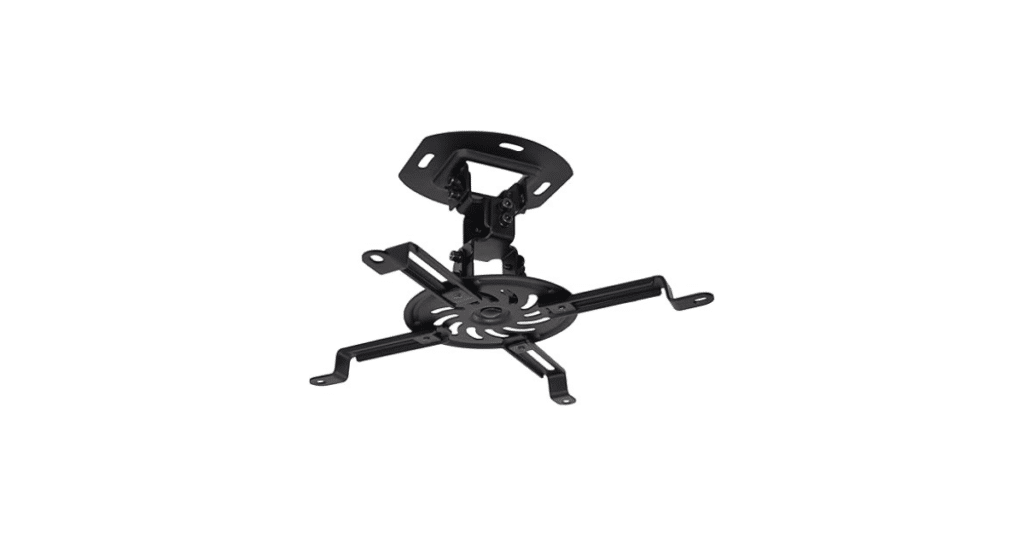
It’s among the most frequently used ceiling mounts for all types of ceilings on Amazon and has reasons that are well-founded. Its extendable arms adjust to accommodate holes with a spacing of 5.25 up to 12.5 inches. That is enough to cover all standard-sized projectors made by big manufacturers. It’s designed to support up to 30 pounds, which gives comfortable headroom above the weight of many household and office projectors.
White finishes blend seamlessly into many ceilings, and the tilt and swivel heads make fine-tuning alignment easy once installed. It’s an excellent choice when you’re not sure of the exact pattern of your projector’s mounting, and you want to have flexibility built-in.
2. WALI Projector Ceiling Mount Tray (PM-005-B)

Instead of a bracket that holds the projector’s mounting holes, the one we have here is an open tray platform, making it an ideal alternative if your projector does not have threaded holes standard to the projector or if you prefer to rest it on a flat surface rather than hanging it. It’s adjustable in height and can hold up to 22 pounds, with a 13.7-inch x 8.6-inch platform that is suitable for the majority of mid-sized and compact projectors.
The design incorporates hidden cable routing so that HDMI as well as power cables will be concealed within the mount instead of hanging in the open. It’s a good compromise between a ceiling bracket that is fully functional as well as a shelf mount.
3. WALI Universal Projector Screen Ceiling Mount (PSM001-W)

This particular mount stands out due to its greater weight capacity, as high as 66lbs — making it suitable for larger projectors or for setups in which the mount is supporting a screen assembly for a projector instead of just that projector. It is designed with an L-bracket that has a 6-inch extension adjustable that allows for the option of varying how much it is able to drop to the floor. Due to its greater loading capacity, it’s a good option for classroom or commercial locations where the projector could be bigger or integrated with other equipment. The white finish helps it not appear obtrusive on the typical ceiling.
4. Suptek Universal Projector Screen Wall Mount (PRL001)

It’s designed to mount screens for projectors instead of the projector; however, it is often utilized in wall-based installations in which a projector and screen are in a room that doesn’t have ceiling access. It utilizes L-brackets that have an adjustable extension of 6 inches and can be rated to support up to 66 pounds for each pair, which includes both electric and manual screens. It is an entire set of two brackets that are sold in white and can be inserted directly into the wall studs. If you are combining the wall-mounted screen with a floor-mounted or shelf projector, this will handle the screen portion of the equation very well.
5. VIVO Universal Metal Ceiling with Low Profile Mount equipped with Scissor Clamp (MOUNT-VP6DP)

Made specifically for ceilings with drops, this mount utilizes the scissor clamp to hold an entire ceiling grid rather than having to use a joist. This is a common issue in basements that have finished offices or ceilings that are suspended. It features the 6.3-inch pole extension as well as adjustable arms that are adjustable to accommodate the various regular and mini projectors. Since it’s located close to the grid on the ceiling, it maintains an appearance that is lower than a typical telescoping mounting, which is perfect for areas with a limited ceiling space. It’s a niche, but it’s an extremely beneficial option if your ceiling isn’t constructed with open joists.
6. BAISHUN Wall and Mini Ceiling Mount

It’s a small mount that folds up and is designed for smaller and mini projectors, rather than larger home theaters. It has 360-degree rotation as well as the ability to adjust tilt or swivel that lets you adjust the angle of your image after mounting. It is connected using an ordinary 1/4 ” screw thread, which can be found on a variety of miniature cameras as well as projectors. Because it folds flatly it’s easy to mount it in tight spaces, or to get it removed completely when it’s not utilized. It can be used as an indoor or mini-ceiling mount and is an efficient, versatile and cost-effective choice for a second-tier or portable installation.
7. YiePhiot Mini Ceiling Wall Projector Mount

The mount is designed around the niche of Mini-projectors with a budget that don’t have OEM mount hardware. It’s described as being compatible with QKK, DR.J, DBPOWER, Anker, VANKYO, AAXA, Jinhoo, PVO, TMY, and AuKing projectors. This covers the majority of the mini-projectors sold on Amazon. The mounting plate measures 175mm, and the black finish makes it small and non-obtrusive. If you have one of these budget mini projectors, but can’t find an accessory that clearly states the brand name, it’s one of the few made specifically with this use case in the back of your mind.
8. Salange Mini Projector Ceiling/Desktop Stand

This stand is dual-purpose and can be used as an elongated ceiling mount or as a folding desktop stand, based on the way you put it up. It can be adjusted 180 degrees for angling the projector in a direction towards the screen. It’s designed to allow for a quick, easy installation, which makes it a great choice for those who don’t need permanent installations. It’s compatible with all small and compact projectors that are used in outdoor, home, and workplace settings. Because it folds, it can also be transported for those who move their projector from room to room or use it outdoors for movie nights.
9. PEGZONE Projector Floor Stand

If you’d prefer to avoid wall or ceiling mounting, the floor stand is completely adjustable between 35 and 48 inches, providing enough space to work in the majority of living spaces or outdoor settings. It is equipped with a sturdy base for stability and is equipped with the standard screw mount of 1/4 inch which is compatible with the bulk of popular consumer projectors as well as cameras. Since it doesn’t need drilling, it’s an excellent option for those who are renting or building an unintentional space such as a dorm space. Its height adjustment allows for repositioning depending on the image’s size and the focus.
10. XGIMI Ceiling Mount for Titan Noir Series
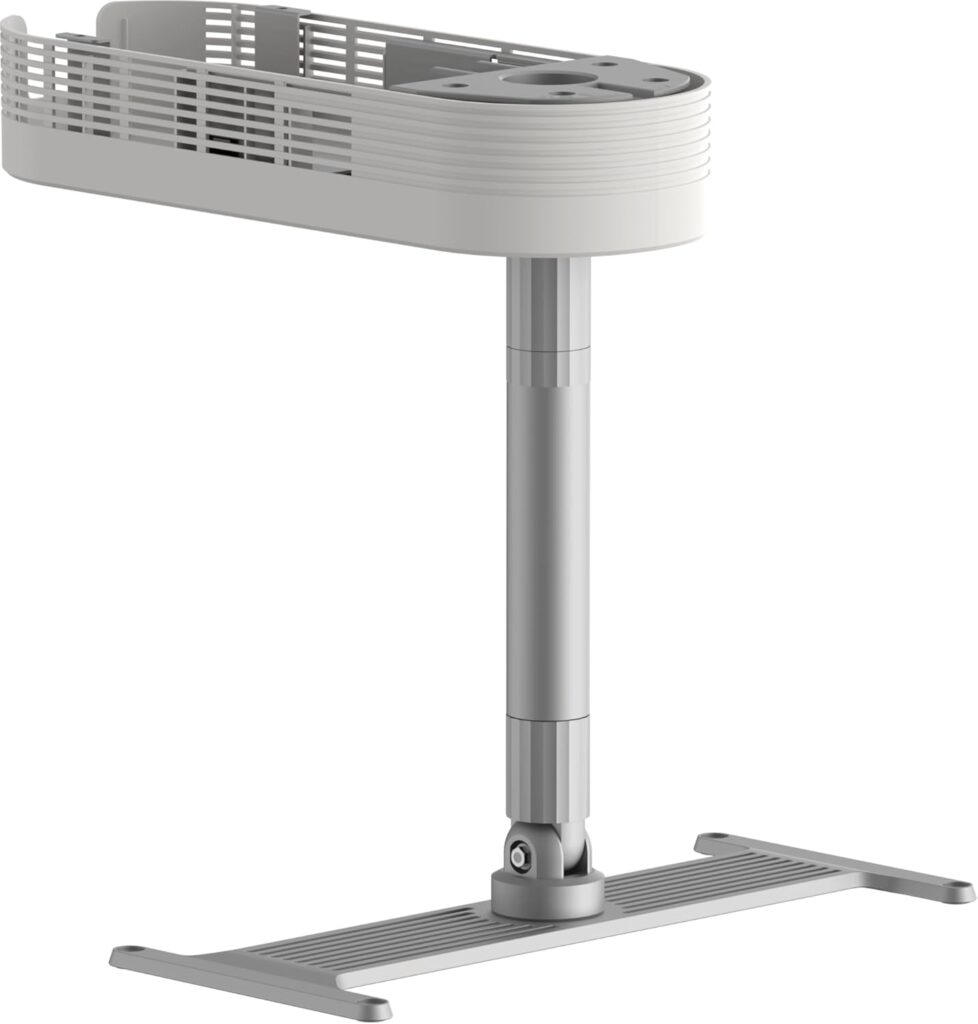
Contrary to the generic options listed above, the mount is an OEM mount specifically designed exclusively for the XGIMI Titan Noir series projectors, which means that all mounting holes, the weight balance, as well as the cable route are specifically designed for that product line. It has built-in cable management, which gives it an improved appearance and is designed to be easy to install without the need to find compatible hardware. If you have a Titan Noir projector, this is the most secure and better-fitting option over the universal bracket. The downside, like the majority of OEM mounts, is that it can only be used with the specific model of projector.
If you’d like to look at the real alternatives rather than go blind, here are a few mounts for projectors that are currently available on Amazon within the US that cover ceiling as well as floor, wall as well as OEM. Prices change frequently, so use these as a guideline and verify the price prior to purchasing.
| Mount | Type | Best For | Notable Specs | Price |
|---|---|---|---|---|
| VIVO Universal Adjustable Ceiling Projector Mount (MOUNT-VP01W) | Ceiling, universal | Standard-throw projectors in most rooms | Holds up to 30 lbs, extending arms with a 12.5-inch mounting range | Check Price |
| WALI Projector Ceiling Mount Tray (PM-005-B) | Ceiling, universal | Setups needing hidden cabling | Height-adjustable tray, holds up to 22 lbs, built-in cable management | Check Price |
| WALI Universal Projector Screen Ceiling Mount (PSM001-W) | Ceiling, universal | Heavier projectors or combined screen/mount installs | L-bracket design, 6-inch adjustable extension, rated up to 66 lbs | Check Price |
| suptek Universal Projector Screen Wall Mount (PRL001) | Wall, universal | Renters or wall-based screen setups | L-brackets with 6-inch adjustable extension, up to 66 lbs capacity per pair | Check Price |
| VIVO Universal Low Profile Metal Ceiling Mount with Scissor Clamp (MOUNT-VP6DP) | Ceiling, low-profile | Drop ceilings and vaulted spaces needing a discreet install | Scissor clamp mounting, 6.3-inch pole extension, extending arms | Check Price |
| BAISHUN Wall and Mini Ceiling Mount | Wall/ceiling, universal | Mini and portable projectors | Foldable design, 360-degree rotation, adjustable tilt and swivel, 1/4-inch thread | Check Price |
| YiePhiot Mini Ceiling Wall Projector Mount | Wall/ceiling, universal | Popular mini-projector brands | Compatible with QKK, DR.J, DBPOWER, Anker, VANKYO, AAXA, Jinhoo, PVO, TMY, and AuKing models | Check Price |
| Salange Mini Projector Ceiling/Desktop Stand | Ceiling/desktop, universal | Small home or office projectors that move between spots | Foldable stand with 180-degree adjustment, quick tool-free setup | Check Price |
| PEGZONE Projector Floor Stand | Floor, universal | Renters, temporary setups, outdoor use | Height-adjustable steel base, 35–48 inches, standard 1/4-inch screw mount | Check Price |
| XGIMI Ceiling Mount for Titan Noir Series | Ceiling, OEM | XGIMI Titan Noir owners wanting a matched, precise fit | Built-in cable management, designed specifically for that projector line | Check Price |
An easy method to utilize this table is to make sure you match with the “Best For” column to your space and the type of projector first, then verify the mount’s weight ratings and hole pattern compatibility with the specific model of projector you are purchasing — the manufacturer’s own compatibility lists (like WALI’s or VIVO’s) generally flags any exclusion models on the product’s page.
FAQ
1. What is the maximum height the projector mount can be above your screen?
It’s based on your projector’s throw ratio as well as its lens offset. The screen’s dimensions is determined by using the calculator offered by the maker to determine exactly the size and height.
2. Can I put up an LCD projector with no drilling holes into the ceiling?
A floor stand, tripod or a shelf will stop ceiling drilling completely. However, you’ll likely need to alter the design more often.
3. How big is the highest capacity the mount on the projector’s screen can manage?
Mounts for projectors that are consumers typically weigh between 15-50lbs (7-23 kilograms). It is important to measure this weight in relation to the projected weight so that you can ensure that you have sufficient space to hold cables.
4. Have you considered fixing your projector on the ceiling or to the wall?
Ceiling mounts are ideal for projectors with standard throws that are placed across the space. Wall mounts are ideal for ultra-short-throw or short-throw projectors which are placed near the projector’s screen.
5. Does putting a projector in a room enhance the image quality?
Indirectly, yes. Fixed mounts remove the jitters and vibrations that table placement causes to keep keystone settings and focus consistent instead of requiring constant adjustment.
6. What is the professional installation cost for a projector?Labor costs typically range from $100-$400 or more, based on the level of complexity of the cable routing process, as well as local costs.
7. Can a mount for a projector be altered after installation?
Most mounts permit tilt, roll, and swivel adjustments even after the plate is in place. Telescoping mounts permit you to change the length of the drop afterward too.
8. Do universal mounts for projectors have the safety for use?
In general, yes, so long as the hole pattern and weight rating correspond to your projector. The tradeoff is that it is less rigid compared to the mount designed for one particular model.
Conclusion
An image projector is an insignificant piece of hardware that has an enormous amount of responsibility in terms of image quality, security, and how the room operates throughout the day. The most appropriate choice boils down to a couple of straightforward questions: how durable is this setup, and what type of throw do you need for your projector, as well as what’s behind the walls or ceiling, and how comfortable do you feel installing it yourself?
Take your time through these steps in order. Make sure you check the exact specifications of your projector in relation to the model you’re looking at. Be sure to include the throw distance calculation because it’s the only procedure that can save you from the most hassle in the future. If you decide to install the mount yourself on a Saturday afternoon or call an integrator for AV, making sure the mount is installed correctly the first time will mean you’ll be able to forget about it and instead look at the display.
These information about Projector Mount are gathered from different surveys, medical tests and tech giants like Amazon, Techradar and more. Our top priority is to provide you valuable information about Projector Mount.
For More Details About Different Projectors Click Here


